
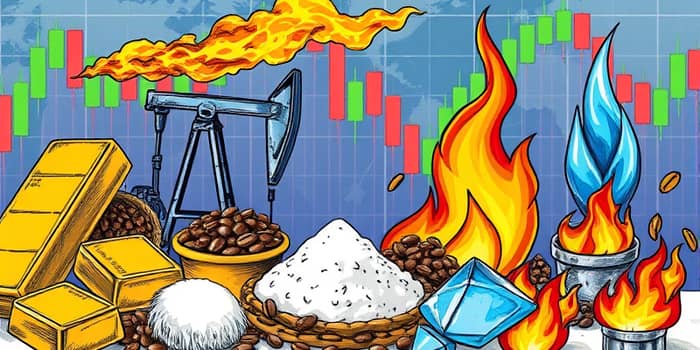
In an era defined by economic uncertainty and global upheaval, commodities offer a tangible pathway to diversification and resilience. From the gleaming allure of gold to the essential energy carried by oil, these assets intertwine with everyday life, offering both stability and opportunity.
Commodity Market Landscape in 2024-2025
The global commodities market has weathered sharp swings over the past three years, with overall volatility reaching levels not seen in half a century. According to industry forecasts, approximately 59% of the most liquid commodities are expected to average lower prices in 2025 after a brief resurgence in 2024.
The Aggregate Commodity Price Index, having grown by 2% in 2024 following a 14% drop in 2023, is projected to decline by 1% in 2025. The World Bank further anticipates an overall fall in commodity prices by about 12% this year, with an additional 5% decline in 2026, ushering in a six-year low.
Key downside risks include a potential economic slowdown, geopolitical tensions, and the strength of the US dollar, each capable of amplifying price fluctuations and market uncertainty.
Major Commodity Sectors
Every commodity category carries its own drivers, risks, and historical narratives. Understanding these sectors is paramount for any investor seeking to balance risk and reward.
Precious Metals: Gold and Silver
Gold reached a record $2,790 per ounce in 2024, while silver climbed to nearly $35 per ounce. Both metals, valued for their role as inflation hedges and safe-haven assets, are forecast to face modest price corrections in the coming year. Investors gravitate toward these metals during periods of market turbulence, trusting in their ability to protect wealth and purchasing power.
Energy Commodities: Oil and Natural Gas
Crude oil prices are under pressure due to OPEC’s production increases and shifting demand patterns. JP Morgan projects Brent crude to average $73 per barrel in 2025, ending the year below $70, while WTI is expected to average $64 per barrel. Natural gas, by contrast, delivered strong returns of 33.8% in 2024, fueled by supply disruptions and heightened demand, making it a focal point for active managers seeking opportunity within price swings.
Agricultural Commodities: Coffee and Sugar
Supply shocks driven by El Niño–related droughts and post-pandemic demand surges propelled coffee prices up 70.8% and sugar prices up 29.9% in 2024. These dramatic gains underscore how weather events and consumer trends can create sharp, unexpected market movements, and highlight the importance of monitoring climatic and consumption patterns.
Industrial Metals and Other Sectors
Beyond metals, agricultural softs and livestock markets experience their own cyclical patterns, influenced by policy changes, global industrial activity, and logistical challenges. Diversification across these subsectors can provide a balanced approach amid varying economic cycles.
Why Invest in Commodities?
Commodities serve as a critical pillar for portfolio construction, offering unique benefits that complement traditional assets.
- Low correlation with stocks and bonds, providing low correlation with traditional asset classes.
- Inflation hedge through assets that tend to rise with consumer prices.
- Potential for exceptional returns during supply disruptions and geopolitical crises.
- Physical asset ownership, delivering physical asset exposure for security in uncertain markets.
Key Risks and Considerations
- Price volatility driven by supply/demand shocks and geopolitical events.
- Leverage and margin risks inherent in futures trading.
- Storage costs and liquidity constraints for certain physical commodities.
- Interest rate shifts and US dollar strength, which can suppress demand.
Investment Vehicles for Commodities
- Futures contracts, offering direct exposure with high leverage.
- ETFs and mutual funds, enabling diversified access without storage concerns.
- Managed commodity pools and professional accounts for pooled expertise.
- Derivative instruments like options and swaps for tailored risk-reward strategies.
Strategy and Best Practices
Successfully navigating the commodities market requires discipline, research, and a strategic mindset. Investors should develop a solid understanding of fundamental drivers—ranging from geopolitical developments to weather patterns—and remain vigilant to macroeconomic indicators that shape price trajectories.
Risk management is paramount: establish clear stop-loss levels, size positions appropriately, and avoid overexposure to any single sector. Embracing careful risk management and prudent diversification helps mitigate shocks, while periodic rebalancing ensures portfolios stay aligned with evolving market conditions.
Long-term success also depends on recognizing market cycles and structural trends. For instance, energy transitions toward renewables may reshape oil and gas demand over time, while industrial expansion in emerging markets can drive metals consumption for decades.
Table of Recent Performance (2024-2025)
Conclusion
Commodity investing in 2025 demands a balanced blend of research, agility, and strategic foresight. While many sectors face downward pressure amid global growth concerns, pockets of strength—like natural gas and agricultural softs—offer investors meaningful opportunities.
By combining diversification across energy, metals, and agriculture with disciplined risk controls, investors can harness the unique advantages commodities provide: protection against inflation, portfolio resilience, and the potential for outsized returns when markets move.
Ultimately, success in this space stems from a commitment to ongoing education, an understanding of fundamental market drivers, and the willingness to adapt as economic landscapes evolve. Embrace the dynamic world of commodities, and unlock the potential that lies within these timeless, essential assets.
References
- https://brainworksinc.com/commodities-market-experienced-traders-2025/
- https://www.straitsfinancial.com/insights/the-benefits-and-risks-of-investing-in-commodities
- https://graniteshares.com/institutional/us/en-us/research/how-to-invest-in-commodities/
- https://www.aberdeeninvestments.com/en-us/institutional/insights-and-research/commodities-the-year-that-was-the-year-that-could-be-2025-inst
- https://www.sofi.com/learn/content/commodity-investing-risks/
- https://www.aberdeeninvestments.com/en-us/investor/insights-and-research/back-into-the-mosh-pit-commodity-investing-in-2025
- https://www.pimco.com/us/en/resources/education/understanding-commodities